





學界資訊


學術活動


政治學報

胡佛院士紀念園地


2025年會專區

2024年會專區

2023年會專區


2022年會專區

2021年會專區

2020年會專區
2019年會專區

歡迎關注中國政治學會粉絲專頁
中國政治學會 Chinese Association of Political Science (CAPS)
會址:10617台北市羅斯福路四段1號 台大政治學系
詢問會務相關事宜請聯繫秘書處: capstaipei28@gmail.com
《政治學報》編輯部: politicalscience351@gmail.com

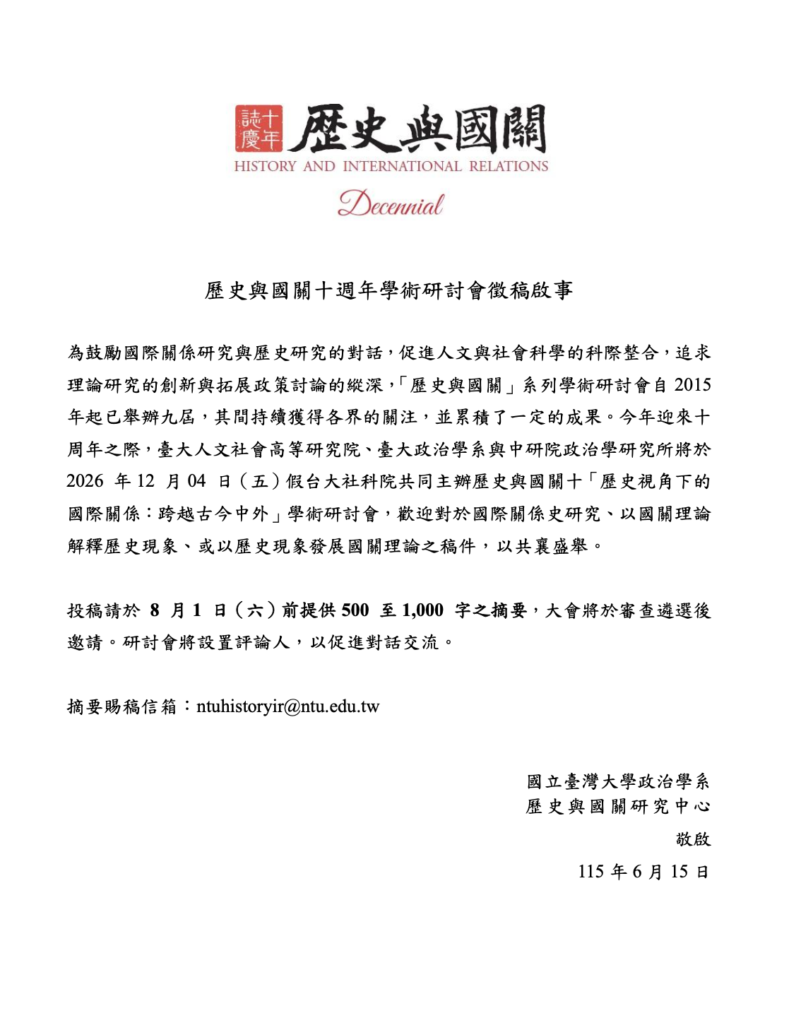
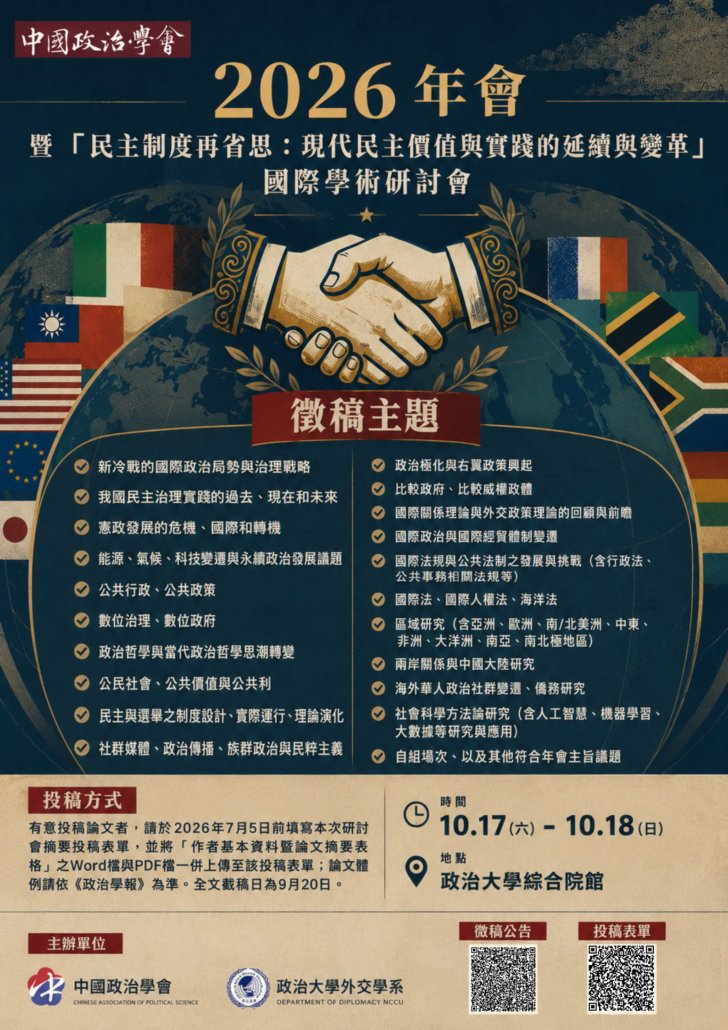
[2026 Annual Conference] Call for Papers & Registration Information: The 2026 Annual Meeting of the Chinese Association of Political Science and International Conference
Abstract Submission Form: https://forms.gle/fpUgusTbp1GzggCu6
As we enter the third decade of the 21st century, global democratic regimes are facing unprecedented and severe tests. As a benchmark of modern democratic practice, modern democratic institutions have demonstrated resilience in recent years amidst political polarization, the rise of populism, and debates over electoral integrity; however, they have also revealed profound structural contradictions. In particular, the political developments following the 2024 U.S. election represent more than just a change in administration; they have triggered a profound global reflection on how the core values of “modern democracy” can be “sustained” and “transformed” under contemporary technological and social changes.
While protectionist and isolationist sentiments are rising within Western democracies, authoritarian blocs are seizing the opportunity to challenge these systems with alternative models of governance. As a bastion of democracy in East Asia, Taiwan has long been deeply embedded within the influence of Western democracy. Faced with the current shift in international politics, our nation must not only pay attention to how the foreign policies of various countries are affected by changing democratic values, but also reflect from an institutional perspective: when traditional democratic models face a crisis of trust, how can emerging democracies strengthen their democratic resilience and governance efficacy?
Accordingly, under these macro-level shifts, re-evaluating the adaptability of democratic institutions and seeking a balance between the continuity of values and structural transformation has become an urgent task for the current political science community. Themed “Rethinking Democracy: The Continuity and Transformation of Modern Democratic Values and Practices,” this annual meeting aims to bring together scholars from home and abroad to engage in in-depth dialogues on issues such as the reconstruction of democratic theory, the evolution of comparative democratic institutions, civic participation in the digital age, and the impact of geopolitical changes on democratic resilience.
Through this academic exchange, we hope not only to diagnose the current state of modern democracy but also to seek strategic paths for Taiwan to deepen the quality of its democracy and optimize national governance within a complex international landscape. In line with this theme, we have outlined several core topics and sincerely invite scholars to submit papers and contribute new perspectives on democracy in this era of change, while providing forward-looking academic insights for our nation’s democratic practices:
- International political and economic landscapes of the “New vs. Old” Cold War and governance strategies
- The past, present, and future of Taiwan’s democratic governance
- Crises, risks, and turning points in constitutional development
- Energy, climate, technological change, and sustainable political development
- Public Administration and Public Policy
- Digital Governance and Digital Government
- Civil society, public values, and the public interest
- Political philosophy and contemporary shifts in political thought
- Institutional design, actual operation, and theoretical evolution of democracy and elections
- Social media, political communication, ethnic politics, and populism
- Political polarization and the rise of right-wing parties
- Comparative Government and Comparative Authoritarianism
- Retrospectives and outlooks on International Relations theory and foreign policy theory
- Changes in international politics and international economic and trade systems
- Development and challenges in international regulations and public law (including administrative law, etc.)
- International Law, International Human Rights Law, Law of the Sea
- Cross-strait relations and Chinese Mainland studies
- Changes in overseas Chinese political communities and diaspora studies
- Regional studies (Asia, Europe, North/South America, Middle East, Africa, Oceania, South Asia, Polar regions)
- Social science methodology (including AI, machine learning, big data research and applications)
- Organized panels and other topics relevant to the conference theme
Conference Time and Venue
- Dates: October 17–18, 2026
- Venue: General Building of Colleges, National Chengchi University
Timeline
- Deadline for Paper Abstracts: July 5, 2026 (Sun)
- Abstract Acceptance Notification: July 24, 2026 (Fri)
- Registration Fee Payment Deadline: August 21, 2026 (Fri)
- Deadline for Full Papers: September 20, 2026 (Sun)
Submission Guidelines
- Interested participants, please complete the abstract submission form by July 5, 2026 (Sun) and upload both the Word and PDF versions of the “Author Information and Abstract Table.”
- Results will be announced on the association’s official website on July 24, 2026 (Fri), and notified to authors via email.
- Full papers should not exceed 20,000 words. Please format your manuscript according to the Political Science Review style guide.
- [Download: Political Science Review Style Guide and Submission Guidelines]
Membership and Registration Fees
- Membership Fee: NT$1,500 per year for faculty members. Valid members enjoy free registration for the annual conference and a subscription to two issues of the Political Science Review per year. We warmly welcome new members.
- Student Registration Fee: NT$750 for students presenting at the conference.
- Important Policy: To ensure the sustainability of our conferences, presenters must be paid-up members for the current year (NT$1,500) by August 21, 2026 (Fri) to be listed in the conference program. Those who do not wish to become members must pay the registration fee (NT$1,500 for faculty, NT$750 for students) by the same deadline to qualify for presentation. Failure to pay by this date will result in the forfeiture of the opportunity to present.
- Payment Unit: Registration fees are per “paper.” For co-authored papers, only one payment is required. Non-faculty/non-student participants will be charged the student rate of NT$750.
Payment Methods (Choose one):
- Online Payment System: [Click here (capstaipei.org.tw)]
- Bank Transfer:
- Bank: Taipei Fubon Bank, Guting Branch
- Account Name: 中國政治學會 (Chinese Association of Political Science)
- Account Number: 8211000-0100047 (Bank Code: 0123903)
- Note: After transferring, please email your receipt/proof of payment to capstaipei28@gmail.com, specifying whether the payment is for “Membership Fee” or “Registration Fee,” along with your contact phone number and name.
For environmental sustainability, we will send an electronic receipt (PDF) via email upon confirmation of payment. If you require a hard copy for reimbursement, please contact the Secretariat.
Contact Information
For any inquiries regarding the conference, please email the Secretariat of the Chinese Association of Political Science:
Email: capstaipei28@gmail.com
The Chinese Association of Political Science welcomes your participation.
Sincerely,
Dr. Hung-Yi Lien
President, Chinese Association of Political Science
Professor, Department of Diplomacy, National Chengchi University
Executive Director, Master’s Program in Strategic and International Studies
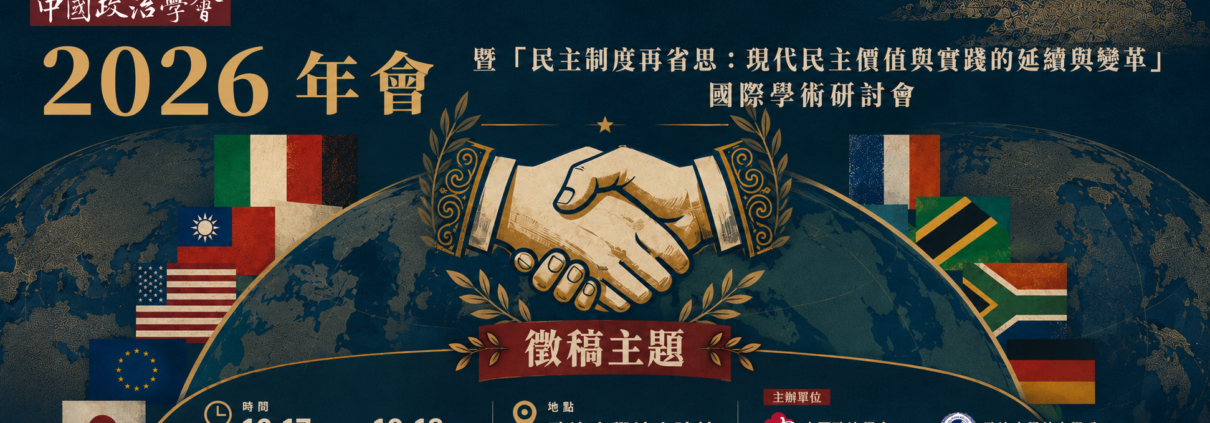
Call for Papers: 2026 CAPS Annual Meeting & International Conference
Theme: Rethinking Democracy: The Continuity and Transformation of Modern Democratic Values and Practices
Submission Form: https://forms.gle/fpUgusTbp1GzggCu6
I. Conference Concept
Entering the third decade of the 21st century, democratic regimes worldwide are facing unprecedented challenges. As a benchmark of modern democratic practice, democracy has demonstrated resilience amidst political polarization, the rise of populism, and debates over electoral integrity, yet it has also exposed deep structural contradictions. The political evolution following the 2024 U.S. election has triggered global reflection on how the core connotations of “modern democratic values” continue or transform under contemporary technological and social shifts.
As protectionism and isolationism rise in the West, authoritarian camps are challenging traditional models with alternative governance styles. As a bastion of democracy in East Asia, Taiwan must not only monitor how foreign policies are affected by these shifts but also consider how emerging democracies can strengthen their “democratic defense” and governance efficiency.
This conference aims to convene international scholars to engage in dialogue on the reconstruction of democratic theory, digital citizenship, and the impact of geopolitical changes on democratic resilience.
II. Core Topics for Submission
We invite submissions on the following (but not limited to) topics:
- Global Geopolitics and Governance Strategies in the “New and Old Cold War”
- The Past, Present, and Future of Taiwan’s Democratic Governance
- Crisis and Resilience in Constitutional Development
- Energy, Climate, and Sustainable Political Development
- Digital Governance and Government
- Civil Society and Public Interests
- Social Media, Political Communication, and Populism
- Political Polarization and the Rise of Right-Wing Parties
- Comparative Authoritarianism
- Cross-Strait Relations and Mainland China Studies
- Methodology in Social Sciences (AI, Machine Learning, Big Data)
- Self-organized Panels
III. Important Dates
- Abstract Submission Deadline: July 5, 2026 (Sun.)
- Notification of Acceptance: July 24, 2026 (Fri.)
- Registration Fee Payment Deadline: August 21, 2026 (Fri.)
- Full Paper Submission Deadline: September 20, 2026 (Sun.)
- Conference Dates: October 17–18, 2026
IV. Submission Guidelines
- Process: Please complete the Online Submission Form and upload your “Author Information and Abstract” (Word & PDF formats) by July 5, 2026.
- Full Paper Requirements: Papers should generally not exceed 20,000 words. Please follow the formatting style of the Chinese Political Science Review (Taipei).
V. Registration and Membership Fees
- Individual Membership (Faculty): NT$1,500/year. Members enjoy waived registration fees and a one-year subscription to the Chinese Political Science Review.
- Registration Fee (Non-members):
- Faculty: NT$1,500
- Students / Others: NT$750
- Note: To be included in the official program and conference handbook, accepted presenters must complete payment by August 21, 2026. Payment is per paper; for co-authored works, only one author needs to pay.
VI. Payment Methods
- Online Payment: Visit the CAPS official website: capstaipei.org.tw.
- Bank Transfer:
- Bank: Taipei Fubon Bank, Guting Branch
- Account Name: Chinese Association of Political Science (中國政治學會)
- Account Number: 8211000-0100047 (Bank Code: 012)
- After transferring, please email a photo of the receipt to capstaipei28@gmail.com with your name and contact number.
VII. Contact Information
Chinese Association of Political Science (Taipei) Secretariat
- Email: capstaipei28@gmail.com
- Address: No. 1, Sec. 4, Roosevelt Rd., Da’an Dist., Taipei City 106319 (CAPS)
Sincerely,
Prof. Hong-Yi Lien
President, Chinese Association of Political Science (Taipei)
Professor, Department of Diplomacy, National Chengchi University
[2026 Annual Conference] Call for Papers & Registration Information: The 2026 Annual Meeting of the Chinese Association of Political Science and International Conference
Abstract Submission Form: https://forms.gle/fpUgusTbp1GzggCu6
As we enter the third decade of the 21st century, global democratic regimes are facing unprecedented and severe tests. As a benchmark of modern democratic practice, modern democratic institutions have demonstrated resilience in recent years amidst political polarization, the rise of populism, and debates over electoral integrity; however, they have also revealed profound structural contradictions. In particular, the political developments following the 2024 U.S. election represent more than just a change in administration; they have triggered a profound global reflection on how the core values of “modern democracy” can be “sustained” and “transformed” under contemporary technological and social changes.
While protectionist and isolationist sentiments are rising within Western democracies, authoritarian blocs are seizing the opportunity to challenge these systems with alternative models of governance. As a bastion of democracy in East Asia, Taiwan has long been deeply embedded within the influence of Western democracy. Faced with the current shift in international politics, our nation must not only pay attention to how the foreign policies of various countries are affected by changing democratic values, but also reflect from an institutional perspective: when traditional democratic models face a crisis of trust, how can emerging democracies strengthen their democratic resilience and governance efficacy?
Accordingly, under these macro-level shifts, re-evaluating the adaptability of democratic institutions and seeking a balance between the continuity of values and structural transformation has become an urgent task for the current political science community. Themed “Rethinking Democracy: The Continuity and Transformation of Modern Democratic Values and Practices,” this annual meeting aims to bring together scholars from home and abroad to engage in in-depth dialogues on issues such as the reconstruction of democratic theory, the evolution of comparative democratic institutions, civic participation in the digital age, and the impact of geopolitical changes on democratic resilience.
Through this academic exchange, we hope not only to diagnose the current state of modern democracy but also to seek strategic paths for Taiwan to deepen the quality of its democracy and optimize national governance within a complex international landscape. In line with this theme, we have outlined several core topics and sincerely invite scholars to submit papers and contribute new perspectives on democracy in this era of change, while providing forward-looking academic insights for our nation’s democratic practices:
- International political and economic landscapes of the “New vs. Old” Cold War and governance strategies
- The past, present, and future of Taiwan’s democratic governance
- Crises, risks, and turning points in constitutional development
- Energy, climate, technological change, and sustainable political development
- Public Administration and Public Policy
- Digital Governance and Digital Government
- Civil society, public values, and the public interest
- Political philosophy and contemporary shifts in political thought
- Institutional design, actual operation, and theoretical evolution of democracy and elections
- Social media, political communication, ethnic politics, and populism
- Political polarization and the rise of right-wing parties
- Comparative Government and Comparative Authoritarianism
- Retrospectives and outlooks on International Relations theory and foreign policy theory
- Changes in international politics and international economic and trade systems
- Development and challenges in international regulations and public law (including administrative law, etc.)
- International Law, International Human Rights Law, Law of the Sea
- Cross-strait relations and Chinese Mainland studies
- Changes in overseas Chinese political communities and diaspora studies
- Regional studies (Asia, Europe, North/South America, Middle East, Africa, Oceania, South Asia, Polar regions)
- Social science methodology (including AI, machine learning, big data research and applications)
- Organized panels and other topics relevant to the conference theme
Conference Time and Venue
- Dates: October 17–18, 2026
- Venue: General Building of Colleges, National Chengchi University
Timeline
- Deadline for Paper Abstracts: July 5, 2026 (Sun)
- Abstract Acceptance Notification: July 24, 2026 (Fri)
- Registration Fee Payment Deadline: August 21, 2026 (Fri)
- Deadline for Full Papers: September 20, 2026 (Sun)
Submission Guidelines
- Interested participants, please complete the abstract submission form by July 5, 2026 (Sun) and upload both the Word and PDF versions of the “Author Information and Abstract Table.”
- Results will be announced on the association’s official website on July 24, 2026 (Fri), and notified to authors via email.
- Full papers should not exceed 20,000 words. Please format your manuscript according to the Political Science Review style guide.
- [Download: Political Science Review Style Guide and Submission Guidelines]
Membership and Registration Fees
- Membership Fee: NT$1,500 per year for faculty members. Valid members enjoy free registration for the annual conference and a subscription to two issues of the Political Science Review per year. We warmly welcome new members.
- Student Registration Fee: NT$750 for students presenting at the conference.
- Important Policy: To ensure the sustainability of our conferences, presenters must be paid-up members for the current year (NT$1,500) by August 21, 2026 (Fri) to be listed in the conference program. Those who do not wish to become members must pay the registration fee (NT$1,500 for faculty, NT$750 for students) by the same deadline to qualify for presentation. Failure to pay by this date will result in the forfeiture of the opportunity to present.
- Payment Unit: Registration fees are per “paper.” For co-authored papers, only one payment is required. Non-faculty/non-student participants will be charged the student rate of NT$750.
Payment Methods (Choose one):
- Online Payment System: [Click here (capstaipei.org.tw)]
- Bank Transfer:
- Bank: Taipei Fubon Bank, Guting Branch
- Account Name: 中國政治學會 (Chinese Association of Political Science)
- Account Number: 8211000-0100047 (Bank Code: 0123903)
- Note: After transferring, please email your receipt/proof of payment to capstaipei28@gmail.com, specifying whether the payment is for “Membership Fee” or “Registration Fee,” along with your contact phone number and name.
For environmental sustainability, we will send an electronic receipt (PDF) via email upon confirmation of payment. If you require a hard copy for reimbursement, please contact the Secretariat.
Contact Information
For any inquiries regarding the conference, please email the Secretariat of the Chinese Association of Political Science:
Email: capstaipei28@gmail.com
The Chinese Association of Political Science welcomes your participation.
Sincerely,
Dr. Hung-Yi Lien
President, Chinese Association of Political Science
Professor, Department of Diplomacy, National Chengchi University
Executive Director, Master’s Program in Strategic and International Studies
Call for Papers: 2026 CAPS Annual Meeting & International Conference
Theme: Rethinking Democracy: The Continuity and Transformation of Modern Democratic Values and Practices
Submission Form: https://forms.gle/fpUgusTbp1GzggCu6
I. Conference Concept
Entering the third decade of the 21st century, democratic regimes worldwide are facing unprecedented challenges. As a benchmark of modern democratic practice, democracy has demonstrated resilience amidst political polarization, the rise of populism, and debates over electoral integrity, yet it has also exposed deep structural contradictions. The political evolution following the 2024 U.S. election has triggered global reflection on how the core connotations of “modern democratic values” continue or transform under contemporary technological and social shifts.
As protectionism and isolationism rise in the West, authoritarian camps are challenging traditional models with alternative governance styles. As a bastion of democracy in East Asia, Taiwan must not only monitor how foreign policies are affected by these shifts but also consider how emerging democracies can strengthen their “democratic defense” and governance efficiency.
This conference aims to convene international scholars to engage in dialogue on the reconstruction of democratic theory, digital citizenship, and the impact of geopolitical changes on democratic resilience.
II. Core Topics for Submission
We invite submissions on the following (but not limited to) topics:
- Global Geopolitics and Governance Strategies in the “New and Old Cold War”
- The Past, Present, and Future of Taiwan’s Democratic Governance
- Crisis and Resilience in Constitutional Development
- Energy, Climate, and Sustainable Political Development
- Digital Governance and Government
- Civil Society and Public Interests
- Social Media, Political Communication, and Populism
- Political Polarization and the Rise of Right-Wing Parties
- Comparative Authoritarianism
- Cross-Strait Relations and Mainland China Studies
- Methodology in Social Sciences (AI, Machine Learning, Big Data)
- Self-organized Panels
III. Important Dates
- Abstract Submission Deadline: July 5, 2026 (Sun.)
- Notification of Acceptance: July 24, 2026 (Fri.)
- Registration Fee Payment Deadline: August 21, 2026 (Fri.)
- Full Paper Submission Deadline: September 20, 2026 (Sun.)
- Conference Dates: October 17–18, 2026
IV. Submission Guidelines
- Process: Please complete the Online Submission Form and upload your “Author Information and Abstract” (Word & PDF formats) by July 5, 2026.
- Full Paper Requirements: Papers should generally not exceed 20,000 words. Please follow the formatting style of the Chinese Political Science Review (Taipei).
V. Registration and Membership Fees
- Individual Membership (Faculty): NT$1,500/year. Members enjoy waived registration fees and a one-year subscription to the Chinese Political Science Review.
- Registration Fee (Non-members):
- Faculty: NT$1,500
- Students / Others: NT$750
- Note: To be included in the official program and conference handbook, accepted presenters must complete payment by August 21, 2026. Payment is per paper; for co-authored works, only one author needs to pay.
VI. Payment Methods
- Online Payment: Visit the CAPS official website: capstaipei.org.tw.
- Bank Transfer:
- Bank: Taipei Fubon Bank, Guting Branch
- Account Name: Chinese Association of Political Science (中國政治學會)
- Account Number: 8211000-0100047 (Bank Code: 012)
- After transferring, please email a photo of the receipt to capstaipei28@gmail.com with your name and contact number.
VII. Contact Information
Chinese Association of Political Science (Taipei) Secretariat
- Email: capstaipei28@gmail.com
- Address: No. 1, Sec. 4, Roosevelt Rd., Da’an Dist., Taipei City 106319 (CAPS)
Sincerely,
Prof. Hong-Yi Lien
President, Chinese Association of Political Science (Taipei)
Professor, Department of Diplomacy, National Chengchi University
[2026 Annual Conference] Call for Papers & Registration Information: The 2026 Annual Meeting of the Chinese Association of Political Science and International Conference
Abstract Submission Form: https://forms.gle/fpUgusTbp1GzggCu6
As we enter the third decade of the 21st century, global democratic regimes are facing unprecedented and severe tests. As a benchmark of modern democratic practice, modern democratic institutions have demonstrated resilience in recent years amidst political polarization, the rise of populism, and debates over electoral integrity; however, they have also revealed profound structural contradictions. In particular, the political developments following the 2024 U.S. election represent more than just a change in administration; they have triggered a profound global reflection on how the core values of “modern democracy” can be “sustained” and “transformed” under contemporary technological and social changes.
While protectionist and isolationist sentiments are rising within Western democracies, authoritarian blocs are seizing the opportunity to challenge these systems with alternative models of governance. As a bastion of democracy in East Asia, Taiwan has long been deeply embedded within the influence of Western democracy. Faced with the current shift in international politics, our nation must not only pay attention to how the foreign policies of various countries are affected by changing democratic values, but also reflect from an institutional perspective: when traditional democratic models face a crisis of trust, how can emerging democracies strengthen their democratic resilience and governance efficacy?
Accordingly, under these macro-level shifts, re-evaluating the adaptability of democratic institutions and seeking a balance between the continuity of values and structural transformation has become an urgent task for the current political science community. Themed “Rethinking Democracy: The Continuity and Transformation of Modern Democratic Values and Practices,” this annual meeting aims to bring together scholars from home and abroad to engage in in-depth dialogues on issues such as the reconstruction of democratic theory, the evolution of comparative democratic institutions, civic participation in the digital age, and the impact of geopolitical changes on democratic resilience.
Through this academic exchange, we hope not only to diagnose the current state of modern democracy but also to seek strategic paths for Taiwan to deepen the quality of its democracy and optimize national governance within a complex international landscape. In line with this theme, we have outlined several core topics and sincerely invite scholars to submit papers and contribute new perspectives on democracy in this era of change, while providing forward-looking academic insights for our nation’s democratic practices:
- International political and economic landscapes of the “New vs. Old” Cold War and governance strategies
- The past, present, and future of Taiwan’s democratic governance
- Crises, risks, and turning points in constitutional development
- Energy, climate, technological change, and sustainable political development
- Public Administration and Public Policy
- Digital Governance and Digital Government
- Civil society, public values, and the public interest
- Political philosophy and contemporary shifts in political thought
- Institutional design, actual operation, and theoretical evolution of democracy and elections
- Social media, political communication, ethnic politics, and populism
- Political polarization and the rise of right-wing parties
- Comparative Government and Comparative Authoritarianism
- Retrospectives and outlooks on International Relations theory and foreign policy theory
- Changes in international politics and international economic and trade systems
- Development and challenges in international regulations and public law (including administrative law, etc.)
- International Law, International Human Rights Law, Law of the Sea
- Cross-strait relations and Chinese Mainland studies
- Changes in overseas Chinese political communities and diaspora studies
- Regional studies (Asia, Europe, North/South America, Middle East, Africa, Oceania, South Asia, Polar regions)
- Social science methodology (including AI, machine learning, big data research and applications)
- Organized panels and other topics relevant to the conference theme
Conference Time and Venue
- Dates: October 17–18, 2026
- Venue: General Building of Colleges, National Chengchi University
Timeline
- Deadline for Paper Abstracts: July 5, 2026 (Sun)
- Abstract Acceptance Notification: July 24, 2026 (Fri)
- Registration Fee Payment Deadline: August 21, 2026 (Fri)
- Deadline for Full Papers: September 20, 2026 (Sun)
Submission Guidelines
- Interested participants, please complete the abstract submission form by July 5, 2026 (Sun) and upload both the Word and PDF versions of the “Author Information and Abstract Table.”
- Results will be announced on the association’s official website on July 24, 2026 (Fri), and notified to authors via email.
- Full papers should not exceed 20,000 words. Please format your manuscript according to the Political Science Review style guide.
- [Download: Political Science Review Style Guide and Submission Guidelines]
Membership and Registration Fees
- Membership Fee: NT$1,500 per year for faculty members. Valid members enjoy free registration for the annual conference and a subscription to two issues of the Political Science Review per year. We warmly welcome new members.
- Student Registration Fee: NT$750 for students presenting at the conference.
- Important Policy: To ensure the sustainability of our conferences, presenters must be paid-up members for the current year (NT$1,500) by August 21, 2026 (Fri) to be listed in the conference program. Those who do not wish to become members must pay the registration fee (NT$1,500 for faculty, NT$750 for students) by the same deadline to qualify for presentation. Failure to pay by this date will result in the forfeiture of the opportunity to present.
- Payment Unit: Registration fees are per “paper.” For co-authored papers, only one payment is required. Non-faculty/non-student participants will be charged the student rate of NT$750.
Payment Methods (Choose one):
- Online Payment System: [Click here (capstaipei.org.tw)]
- Bank Transfer:
- Bank: Taipei Fubon Bank, Guting Branch
- Account Name: 中國政治學會 (Chinese Association of Political Science)
- Account Number: 8211000-0100047 (Bank Code: 0123903)
- Note: After transferring, please email your receipt/proof of payment to capstaipei28@gmail.com, specifying whether the payment is for “Membership Fee” or “Registration Fee,” along with your contact phone number and name.
For environmental sustainability, we will send an electronic receipt (PDF) via email upon confirmation of payment. If you require a hard copy for reimbursement, please contact the Secretariat.
Contact Information
For any inquiries regarding the conference, please email the Secretariat of the Chinese Association of Political Science:
Email: capstaipei28@gmail.com
The Chinese Association of Political Science welcomes your participation.
Sincerely,
Dr. Hung-Yi Lien
President, Chinese Association of Political Science
Professor, Department of Diplomacy, National Chengchi University
Executive Director, Master’s Program in Strategic and International Studies
Call for Papers: 2026 CAPS Annual Meeting & International Conference
Theme: Rethinking Democracy: The Continuity and Transformation of Modern Democratic Values and Practices
Submission Form: https://forms.gle/fpUgusTbp1GzggCu6
I. Conference Concept
Entering the third decade of the 21st century, democratic regimes worldwide are facing unprecedented challenges. As a benchmark of modern democratic practice, democracy has demonstrated resilience amidst political polarization, the rise of populism, and debates over electoral integrity, yet it has also exposed deep structural contradictions. The political evolution following the 2024 U.S. election has triggered global reflection on how the core connotations of “modern democratic values” continue or transform under contemporary technological and social shifts.
As protectionism and isolationism rise in the West, authoritarian camps are challenging traditional models with alternative governance styles. As a bastion of democracy in East Asia, Taiwan must not only monitor how foreign policies are affected by these shifts but also consider how emerging democracies can strengthen their “democratic defense” and governance efficiency.
This conference aims to convene international scholars to engage in dialogue on the reconstruction of democratic theory, digital citizenship, and the impact of geopolitical changes on democratic resilience.
II. Core Topics for Submission
We invite submissions on the following (but not limited to) topics:
- Global Geopolitics and Governance Strategies in the “New and Old Cold War”
- The Past, Present, and Future of Taiwan’s Democratic Governance
- Crisis and Resilience in Constitutional Development
- Energy, Climate, and Sustainable Political Development
- Digital Governance and Government
- Civil Society and Public Interests
- Social Media, Political Communication, and Populism
- Political Polarization and the Rise of Right-Wing Parties
- Comparative Authoritarianism
- Cross-Strait Relations and Mainland China Studies
- Methodology in Social Sciences (AI, Machine Learning, Big Data)
- Self-organized Panels
III. Important Dates
- Abstract Submission Deadline: July 5, 2026 (Sun.)
- Notification of Acceptance: July 24, 2026 (Fri.)
- Registration Fee Payment Deadline: August 21, 2026 (Fri.)
- Full Paper Submission Deadline: September 20, 2026 (Sun.)
- Conference Dates: October 17–18, 2026
IV. Submission Guidelines
- Process: Please complete the Online Submission Form and upload your “Author Information and Abstract” (Word & PDF formats) by July 5, 2026.
- Full Paper Requirements: Papers should generally not exceed 20,000 words. Please follow the formatting style of the Chinese Political Science Review (Taipei).
V. Registration and Membership Fees
- Individual Membership (Faculty): NT$1,500/year. Members enjoy waived registration fees and a one-year subscription to the Chinese Political Science Review.
- Registration Fee (Non-members):
- Faculty: NT$1,500
- Students / Others: NT$750
- Note: To be included in the official program and conference handbook, accepted presenters must complete payment by August 21, 2026. Payment is per paper; for co-authored works, only one author needs to pay.
VI. Payment Methods
- Online Payment: Visit the CAPS official website: capstaipei.org.tw.
- Bank Transfer:
- Bank: Taipei Fubon Bank, Guting Branch
- Account Name: Chinese Association of Political Science (中國政治學會)
- Account Number: 8211000-0100047 (Bank Code: 012)
- After transferring, please email a photo of the receipt to capstaipei28@gmail.com with your name and contact number.
VII. Contact Information
Chinese Association of Political Science (Taipei) Secretariat
- Email: capstaipei28@gmail.com
- Address: No. 1, Sec. 4, Roosevelt Rd., Da’an Dist., Taipei City 106319 (CAPS)
Sincerely,
Prof. Hong-Yi Lien
President, Chinese Association of Political Science (Taipei)
Professor, Department of Diplomacy, National Chengchi University